The $10,000 LeBron Trade That Changed How I Look at Sports Cards
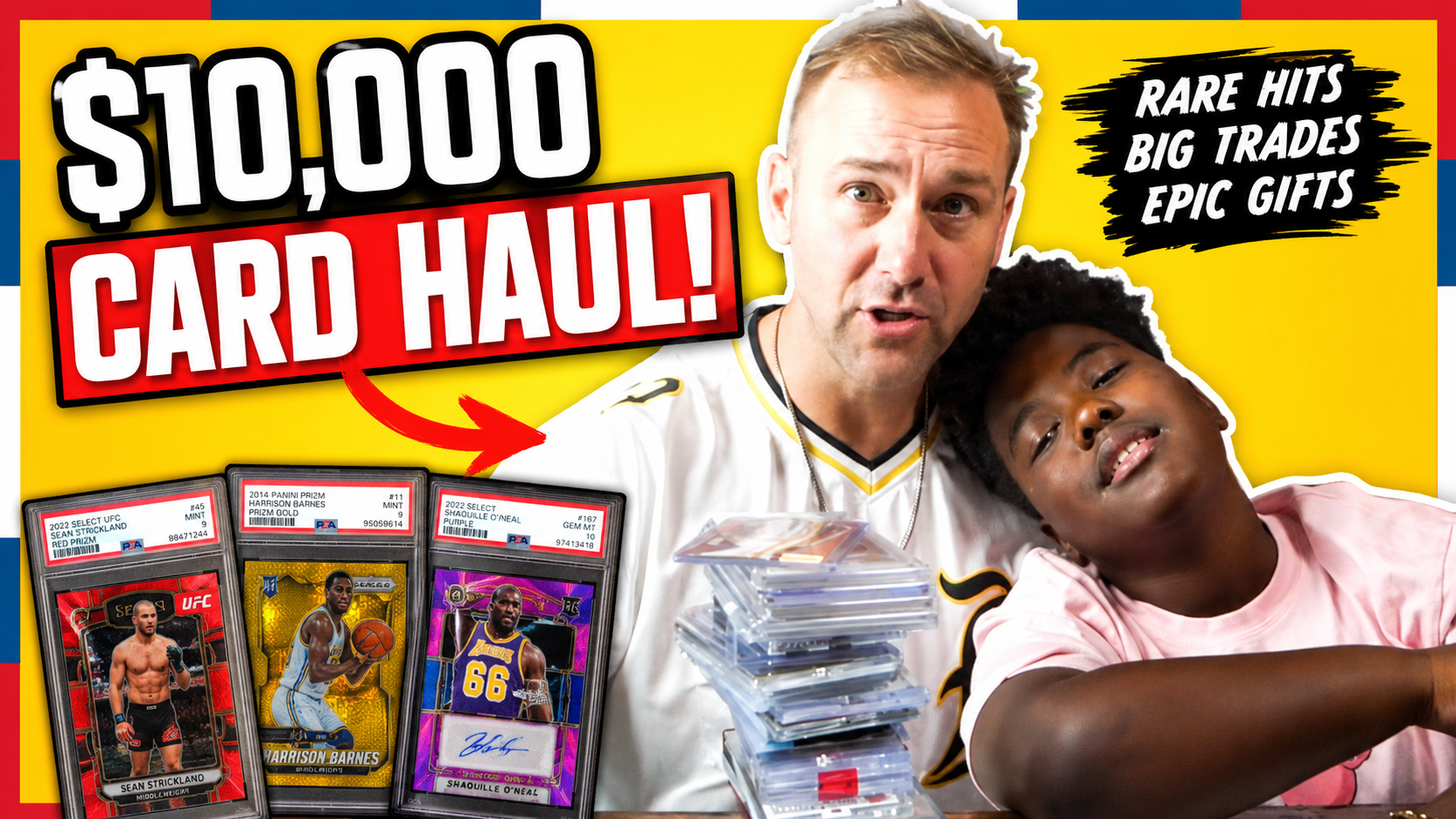
Fanatics Fest produced plenty of memorable pickups, but the biggest takeaway from the trip wasn’t really about how many cards came home.
It was about what deserves a permanent place in a collection.
There were inexpensive pickups, gifts, autographs, rare inserts and even a one-of-one. But everything eventually led to one major decision: moving out of a high-population LeBron James rookie and into a rarer version of the same iconic card—even though the new card came with some significant flaws.
That trade says a lot about how my collecting strategy is changing.
Sometimes the Deal Matters as Much as the Card
One of the first purchases was a True Gold Prizm Harrison Barnes.
As a Warriors collector, Harrison Barnes represents a specific era of basketball I enjoyed watching. The card itself was exactly the kind of thing I like: a player connected to those championship runs combined with a True Gold Prizm design.
The asking price was around $220.
I offered $200.
The dealer wouldn't move on the price, so I eventually paid the full $220. I still liked the card, but I didn't like the interaction surrounding it.
That matters more than people might realize.
Later, I found another card from dealers who handled the transaction completely differently. I threw out a $50 offer, and they actually countered at $40.
Of course I took the deal.
The difference between those two experiences reinforced something I've learned after years in the hobby: the memory attached to a card can affect how much you enjoy owning it.
I've actually sold cards because I didn't like the experience attached to acquiring them, then bought another copy elsewhere.
A collection isn't just cardboard. It's also a collection of stories.
The Unexpected Cards Can Be the Most Memorable
Some of the best moments weren't purchases at all.
A young collector offered me a Jordan Poole printing plate as a gift. I didn't want him losing money just to give me something, so I gave him $20.
Another collector gave me a purple card numbered to 49.
Those aren't necessarily the biggest financial pieces from the weekend, but interactions like those are part of what makes card shows worth attending.
The same thing happened with a Peyton Manning card purchased before Fanatics Fest.
I found it while traveling through Knoxville and bought it partly because I like picking up cards that remind me of trips. It was priced at $30, and although I initially asked about $20, I ultimately just paid the asking price.
Later, the people behind the shop saw the video, found me at Fanatics Fest, handed me the $30 back and even gave me a magnetic holder for the card.
That turned a relatively inexpensive Peyton Manning card into something I'll probably keep forever.
Price doesn't always determine importance.
The Players I'm Watching
The show also provided opportunities to add cards from players I think are interesting from a collecting perspective.
One was a Shaquille O'Neal Planet Metal insert.
I've been buying Shaq inserts for years because I think he's been undervalued relative to some of the other all-time greats. His cards appear to be getting more attention, and one possible reason is simple: collectors who have been priced out of Michael Jordan and Kobe Bryant inserts may start looking elsewhere.
Shaq is an obvious candidate.
Tim Duncan is another player I've been watching. His rookies have been moving, which makes his inserts another category worth paying attention to.
The goal isn't simply to chase whatever has already gone up. It's to identify important players and cards I actually want to own.
Adding a One of One
Another highlight was a Jared McCain black one-of-one.
I had already been looking at McCain cards, and this was an opportunity to add something truly unique.
The deal involved roughly $600 in cash along with a couple of other autographs.
I also managed to get another McCain card signed at the show. The signature ended up smaller and thinner than I would have preferred, but that's another card with an experience attached to it.
And then came the biggest decision of the entire trip.
Selling My LeBron Topps Chrome Rookie
I'd owned a LeBron James Topps Chrome rookie graded BGS 9.5 for several years.
I originally paid around $3,200 for it and later spent another $300 attempting to cross it into a PSA 10.
It didn't cross.
That put my total investment at roughly $3,500.
At one point, the card fell all the way to around $1,800. Instead of panicking, I held it. It's an iconic LeBron rookie, and I still believed in the card.
Eventually, prices recovered dramatically, with sales reaching roughly the $6,000–$8,000 range.
That's when another factor started bothering me:
population.
There are more than 22,000 graded examples of the Topps Chrome card according to the population figure I was looking at.
That's a lot of copies for a card carrying that kind of value.
So I brought mine to the show and eventually sold it for around $6,200.
Financially, I was comfortable with the deal.
Emotionally, I wasn't.
I Immediately Wanted the Card Back
After selling it, I kept thinking about what I'd given up.
I still wanted an important 2003 LeBron card anchoring the collection. But rather than simply buying another copy of the same base card, I started thinking differently.
There was a Topps Chrome refractor sitting on the show floor.
That was the opportunity.
Instead of owning one of the best graded versions of the more common card, I could own a flawed version of the significantly rarer refractor.
That's exactly what I did.
Trading Roughly $10,000 Into the Refractor
The refractor wasn't cheap.
The deal included approximately $5,400 in cash plus several cards, including a Kobe Bryant Topps rookie PSA 10 and additional LeBron and Jordan cards.
Based on the values involved, the total trade was somewhere around $9,000 to $10,000.
But my actual cost basis in those trade pieces was considerably lower.
The Kobe, for example, had originally been an SGC 9.5 that successfully crossed to a PSA 10. Because of how I'd acquired some of the cards, I estimate my real out-of-pocket cost in the refractor at closer to $6,000.
There's another major difference.
Instead of a population above 22,000, the refractor population I was looking at was only around 2,600.
That scarcity matters to me.
There's a Catch
This isn't a beautiful high-grade refractor.
It's authenticated as altered.
There also appears to be blue coloring along the sides. After having someone examine it, the theory was that a previous owner may have attempted to soak or clean the card and didn't do a particularly good job.
That's obviously not ideal.
If I eventually get an opportunity to buy a PSA 7 or PSA 8 refractor at a price that makes sense, I'd happily move out of this one and upgrade.
But for now, I have the card I wanted.
And that's more important to me than having a perfect label.
Why I'm Moving Away From High-Pop PSA 10s
The LeBron deal represents a larger shift in how I'm approaching sports cards.
I've been looking much more carefully at population counts.
And I've increasingly been selling high-population base PSA 10s from players I collect—including names like Jordan, LeBron and Kobe—and moving toward inserts and lower-population cards.
My concern is straightforward:
I think the PSA 10 label can sometimes command too much of the card's value.
A perfect grade is obviously desirable. But when thousands or tens of thousands of copies exist, I'd rather ask what I'm actually buying.
Am I buying rarity?
Am I buying an important version of the card?
Or am I mostly paying a premium for the number on the slab?
For my collection, I'm increasingly choosing rarity.
The Worst Version of a Better Card
That's ultimately how I think about this LeBron trade.
I moved from one of the best versions of a base card into one of the worst versions of a better card.
The refractor is altered. It has issues. It isn't the copy I'd choose if money were unlimited.
But it's still the refractor.
It's rarer, visually distinct and represents the version of this iconic LeBron rookie that I ultimately wanted in my collection.
There are certain players who deserve anchor cards in a personal collection. For me, LeBron is one of them.
So even after selling the BGS 9.5, I knew I wasn't finished with this card.
I just wanted to own it differently.
And that's the question this entire Fanatics Fest trip left me thinking about:
Would you rather own the highest-grade version of a common base card—or a flawed version of the rarer card you really wanted?